Handel's Messiah at Great Malvern Priory
Jim Gumbley · Music · · 6 min read
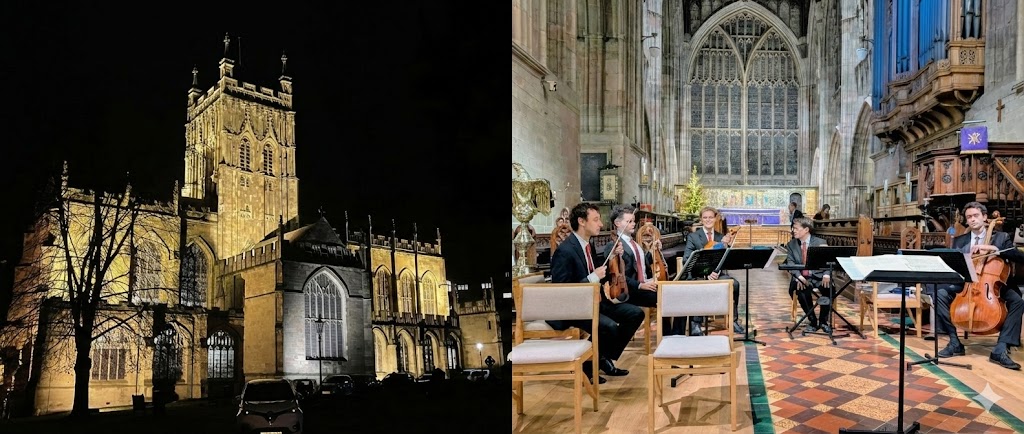
Last night Grace and I were back at the Priory in Great Malvern for Handel's Messiah plus festive extras, performed by Eboracum Baroque.1
The group return each year, and it was our second year in a row hearing it live. First time round, I mainly experienced it as "oh, this is where that Hallelujah thing everyone stands up for comes from". This time, my brain did something different: it started tracking the counterpoint.
Handel at 56, slightly on the ropes
Messiah feels familiar now, but in 1741 it was a pivot.
By then Handel was 56, not the young hotshot of the London opera scene anymore. Italian opera — the thing that had made his name — was losing money. He'd had financial trouble, health trouble (including a stroke in 1737), and the London audience had moved on.
Enter Charles Jennens, a wealthy, opinionated landowner who assembled a libretto entirely from the King James Bible and the Psalms. No original poetry, no narrative dialogue — just scripture, stitched into a theological arc. Handel took this text and wrote the whole thing in about 24 days.
Then he didn't premiere it in London. He took it to Dublin.
The first performance was a charity gig — raising money for prisoners' debt relief and hospitals. A German composer, with a Protestant English libretto, premiering in Anglican Dublin as a fundraiser for very practical, earthly problems. Less incense, more infrastructure.
Very Protestant, and middle class
Sitting in the priory, it struck me how Protestant this thing is — not in the "angry Reformation pamphlet" sense, but in its DNA. The text is King James Bible all the way down. It's sung in English, originally performed in a secular space, as a concert, not as part of a service. No saints. No Marian devotion. No liturgy of the Mass.
And yet it doesn't feel sectarian. Textually and historically, it's distinctly Protestant. Musically and emotionally, it wants to be public property.
It's also not distinctly aristocratic. Oratorio was Handel's smart adaptation to the English middle class. Italian opera was expensive, Italian, and full of castrato stars — a prestige product for the aristocracy. Oratorio kept the dramatic sweep and musical sophistication but dropped the staging and the language barrier. Public halls, ticketed concerts, a work that sounded pious and respectable but was fundamentally a night out.
There's a weird continuity in hearing it now. We're no longer in wigs-and-candles London, but the basic structure is the same: a paying audience, a mixed level of musical literacy, and a work that works whether you've come for theology, nostalgia, or just something Christmassy that isn't Mariah Carey.
User-centred complexity
What hit me last night was the counterpoint — especially in movements like "For Unto Us a Child Is Born" — those strands entering one after another, locking together, peeling away.
It's easy to hear "Baroque counterpoint" and think extreme complexity. But there's a difference between compositional complexity (how many things are technically happening) and perceptual complexity (how many of those things a human brain can actually track).
Earlier music could be wildly dense on paper — six, eight, even forty independent vocal lines. But in the ear, you don't hear forty separate melodies; you hear the effect of a shimmering harmonic cloud.
Handel, by comparison, is often "simpler" on paper. Fewer lines; clearer structures. But that doesn't mean simplistic. It feels like deliberately restrained complexity: enough lines to be interesting, few enough that you can actually follow them, like a conversation.
I found myself tracking individual entries — tenors here, altos there — then suckered by the harmonic punch when everyone lands together. That's sophisticated writing aimed at human perception, not at impressing other composers.
The human cost
A thing you don't get from scores or recordings: this music is physically hard work.
The chorus needs stamina. This isn't one big hit and done; it's long, with demanding fugal writing and rapid text. The soloists are running a technical and emotional marathon — the soprano in "Rejoice Greatly" demands agility, the alto in "He Was Despised" has to sustain a long, exposed emotional line with nowhere to hide.
Watching it live, you become aware it's not just notes. It's bodies and lungs and lips and nerves. The singers were so talented.
Then there's the band. Historical performance groups lean into period instruments, and if you're lucky, natural horns. These things are ridiculous in a heroic way: no valves, just a length of tubing plus the player's face. They only get notes from the natural harmonic series, some of which are naturally out of tune and have to be "lipped" back into place.
The horn player in Eboracum Baroque doubles as their leader and conductor. I have a lot of respect for the sheer risk he's taking moving from introducing the songs to conducting to hitting the key notes on the horn. It sounds bright and burnished and very "of the period", the cherry on top of the cake in a way. And you don't get that sense of risk from a studio recording the way you do from a live priory acoustic, with cold fingers and winter air.
Why it still lands
Walking out afterwards, I kept circling back to that initial experience of the counterpoint. There's a lot about Messiah that's historically specific: the Protestant theology, the class dynamics, the performance traditions.
But the reasons it still works feel surprisingly straightforward. It respects the limits of human perception. It's built for live performance in real spaces, with real humans who get tired and cold and nervous. It takes the dense theology of English Christmas and turns it into something shapely, singable, and public.
For a cold Friday evening in December sitting in a stone building, it was once again a refreshingly warm and soothing experience.
-
The concert was Handel's Messiah Part I and Festive Favourites, performed by Eboracum Baroque. They sell a CD on their site of the Messiah which is £7.50, I have a copy in the mail. You can pay via PayPal. ↩